Information for learners
Know the code
Code of Practice for Tertiary and International Learners
We are a signatory to the Education (Pastoral Care of Tertiary and International Learners) Code of Practice 2021
What does this mean for our learners?
We have a commitment to ensuring our tertiary and international learners are well supported and safe while they are training with us.
We commit to:
- Having a transparent and supportive system for learner wellbeing and safety.
- Responding to diverse learner needs and wellbeing in a way that upholds their mana and autonomy.
- Having safe, inclusive, and supportive learning environments.
- Supporting our ākonga/learners to succeed in their learning.
To review our performance against the Code of Practice, please have a read of our self-assessment document.
Site Safe is committed to the health, safety and wellbeing of its learners and others and will ensure we have strategies, policies, and procedures in place to achieve this commitment. Site Safe aims to enhance our inclusive, caring and supportive community by positively promoting good health and wellbeing (social, physical and mental) as the foundation for learner success and a great learning experience.
We honour our commitment to provide learners with an inclusive and safe learning experience with Site Safe in alignment with the principles of Te Tiriti o Waitangi - Participation, Protection, and Partnership.
Read our commitment statement.
If you have any feedback or comments on the Learner Health, Safety and Wellbeing Commitment Statement, please email education@sitesafe.org.nz.
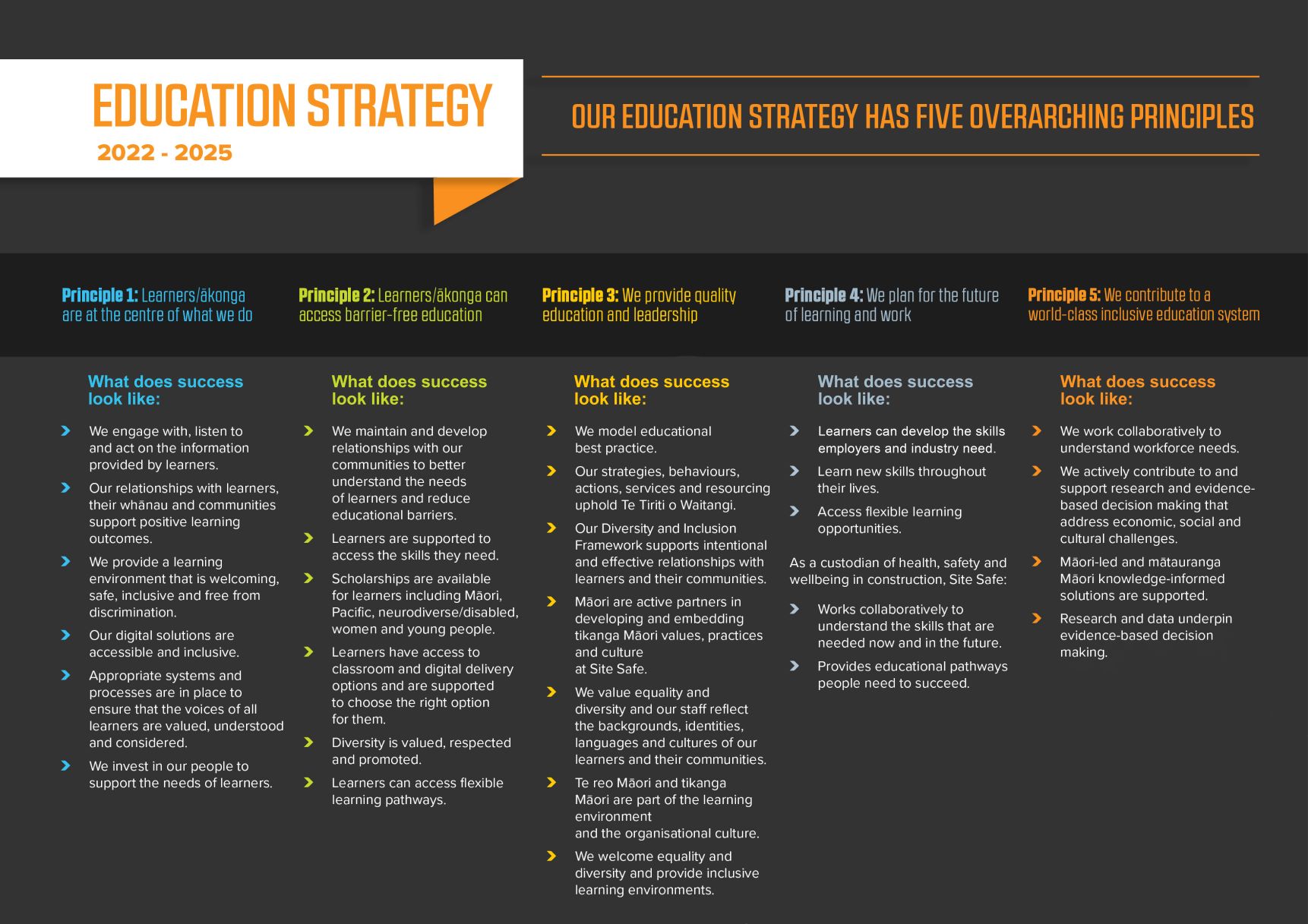
In 2022, Site Safe developed an Education Strategy that identifies key actions to create an environment where learners can thrive, and provide economic, social and cultural benefits to health, safety, and wellbeing to the construction industry.
Anyone who lives in New Zealand on a Work or Student Visa is considered an international learner. If this is you, we will provide you with the same learning support that we provide for New Zealand citizens and residents.
We will also make sure that you have access to information and advice about studying, working, and living in New Zealand (see the learner guide for links and guidance).
In addition to this, we will keep an accurate record of your identification and visa details. Please be aware that we may ask you to bring your passport and evidence of your visa to the course. If you enrol into the Health and Safety in Construction programme, we may also require you to provide evidence of your English language proficiency skills.
If you are an international learner and need help or support with filing a complaint, iStudent Complaints can support you through the complaints process.
NZQA have some excellent information about the Code of Practice and what this means for ākonga/learners. They also have videos that aim to support learners' understanding of the Code of Practice.
If you feel that you have been unfairly treated or wronged during the course, you have the right to make a formal complaint.
To lodge a complaint, you must submit a written statement outlining the circumstances and reasons for the complaint. Your complaint is to be sent within 10 working days from the end of the course by either:
- Completing our Online Complaint Form, which will be sent directly to our Education Team.
- Sending an email to: education@sitesafe.org.nz
- Via post to Site Safe New Zealand, PO Box 9445, Wellington, 6011 Attention: Education Manager.
- Calling us on 0800 SITE SAFE (748 372) and talking with our team.
There are three main types of complaints we see:
- Academic - A complaint about your learning experience with us. Examples may include significant delay in returning assignments, a delay in resolving your appeal, or the material provided is inadequate.
- Behaviour - A complaint about the behaviour of either a staff member or another ākonga/ learner. Examples may include inappropriate comments, sexist behaviour, rudeness or bullying, comments about your appearance, gender identity, sexual orientation, race, religion, background, or beliefs.
- Service - A complaint about the service that you have received from us. Examples may include the enrolment process, fees, or facilities.
A member of our Education Team will carry out a formal investigation into the circumstances of the complaint. We will advise you of the results/decision made regarding your complaint and any actions to be taken to resolve the matter.
If you feel that we have not resolved your complaint, you can seek further support through the Tertiary Education Dispute Resolution team, who will work with you, and us, to reach a resolution.
Learner complaints
Site Safe values learner feedback and is committed to providing fair, accessible and transparent processes for raising concerns or making a complaint.
We record and review learner complaints to help us understand learner experiences, identify trends, and improve our education and training practices. Complaints information forms part of our learner voice and continuous improvement processes and is reviewed alongside other learner feedback.
The below provides aggregate complaints data for the reporting period, including the nature of complaints received and whether they have been resolved.
Learner complaints data
For the reporting period 1 January 2025 to 22 June 2026, Site Safe recorded 36 learner complaints. Of these, 33 have been resolved and 3 remain open.
Complaints were recorded across the following categories:
- Academic: 5 complaints — 3 resolved and 2 open. These related to course content and assessment, course recommendation or fit, and trainer and delivery.
- Behaviour: 1 complaint — resolved. This related to trainer conduct.
- Other: 2 complaints — both resolved. These related to safety communication and an unspecified trainer/classroom matter.
- Service: 23 complaints — 22 resolved and 1 open. These related to account and profile management, billing and fees, booking and enrolment, cards and certification, communication and support, booking system issues, and website/login usability.
- Out of scope: 5 complaints — all resolved. These related to external matters and staff/driver conduct.
Overall, 92% of complaints received during the reporting period have been resolved, with three complaints remaining open.
For reporting purposes, a complaint is an expression of dissatisfaction about a learner's experience with Site Safe that requires a response or resolution through our complaints process. For more nformation on how to make a complaint, please refer to our Learner Guide.
As a private Training Establishment, NZQA periodically reviews Site Safe New Zealand to check on our performance. To access these reports, please visit the NZQA website.
Site Safe is committed to creating a safe, inclusive and supportive learning environment. As part of this commitment, we have provided a summary report against the eight key outcomes of the Education Code of Practice 2021.